The Journal
NTR's Revolutionary Reform of 1985
Dissolving 305 Colonial Talukas from Existence! Government at Every Village's Doorstep!
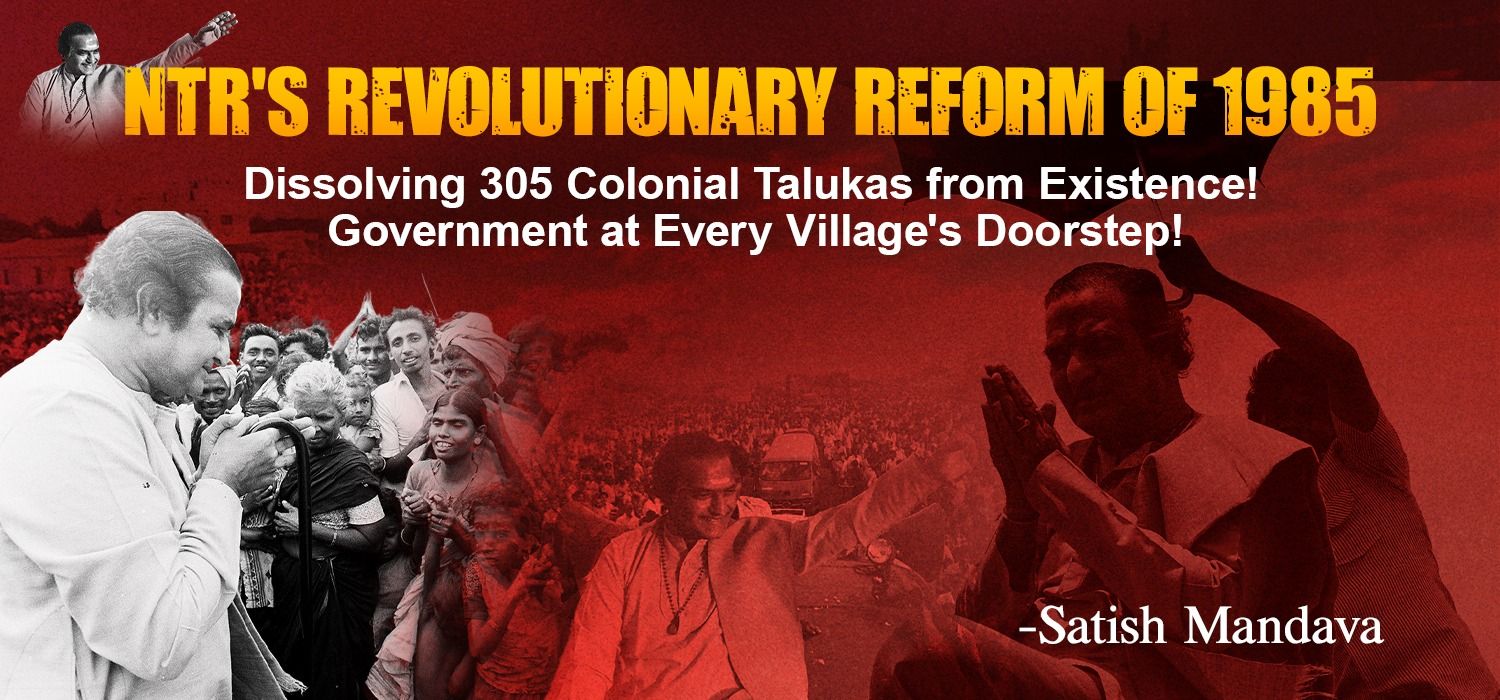
What did the legendary Nandamuri Taraka Rama Rao do in May 1985 that most governments have talked about but never pulled off since India obtained independence? He eliminated Andhra Pradesh’s 305 Talukas, an ancient administrative system left behind by the British and the Nizam and replaced them with over 1,100 Mandals. We have lived long enough to see a lot of ‘reform’ in governance over the years, and we know that most of them were just new paint on an old, collapsing wall. This was not one of those. Whether you love NTR or hate him, the Mandal reform revolutionized how administration worked on the ground. It seemed almost too easy on paper. Bring the government closer to the people. Cut the bureaucracy. Facilitate getting things done for an ordinary resident without having to go across half a district. Here's the funny thing. Many of those reforms implemented since independence are already a part of history, but the Mandal system remains very much alive, nearly four decades later. In fact, Andhra Pradesh and Telangana are the only states where this paradigm continues. That says much. Governments don’t continue with an administrative experiment for forty years unless it’s solving a serious problem. Why the Taluka System Had to Go? You can't really appreciate what NTR did in 1985 unless you first understand just how broken the Taluka system had become. And no, this wasn't one of those problems politicians suddenly "discovered." People had been living with it for decades. The Taluka setup was basically a colonial hand-me-down. The British built it for administrative convenience, and the old princely states kept it alive. By the early 1980s, though, it had stopped serving citizens and started serving the bureaucracy. ➢ The first problem was scale. Talukas had grown too big. A single Taluka often covered dozens of villages spread over huge distances. If a farmer needed a land record corrected or a student wanted a caste certificate, it wasn't a quick visit to a government office. It could easily mean losing an entire day just travelling back and forth. That's not public service. That's bureaucracy making life harder than it needs to be. ➢ Then there was the concentration of power. Despite all the talk about decentralization, authority was still funnelled through hereditary village functionaries such as the Karanam, Munsabu, and Patel-Patwari. These institutions belonged to another era. By the 1980s, many people saw them as outdated, opaque, and resistant to change. The system protected itself far better than it served the public. ➢ Even Panchayati Raj wasn't delivering what it was supposed to. Local self government sounded great on paper, but when the administrative machinery sitting above villages was oversized and painfully slow, grassroots democracy never really got the room it needed to function properly. One thing that gets lost in the storytelling is this: The Mandal system didn't suddenly appear because NTR had a flash of inspiration to reorganize the administration. By the time he became Chief Minister in 1983, experts, administrators, and policymakers had already been arguing that the Taluka system had outlived its usefulness. In 1977, the Ashok Mehta Committee was asked ny the central government to find out why the Panchayati Raj system in India had stalled delivering results. The committee decided that after twenty years of mixed results, the administrative machinery of village governments was too big, too slow, and too far from the ordinary people. What was unusual was that NTR didn't just talk about reform — he actually signed the file. Its answer was straightforward. Shrink the distance between citizens and the state. Build a smaller, more accessible administrative unit instead of relying on oversized Talukas. What later became the Mandal model drew heavily from that line of thinking. Now here's where the story gets interesting. Committees in India are famous for producing reports that gather dust. Governments announce them, hold a press conference, print a few hundred copies, and then quietly move on. Anyone who's spent a decade watching public administration has seen that movie more times than they can count. And NTR broke that pattern. While several states examined the Ashok Mehta Committee's recommendations, Andhra Pradesh was among the first to translate many of those ideas into a major administrative restructuring. He didn't treat the report as another academic exercise. He used it as a blueprint for action, abolishing the Taluka system and introducing Mandals across the state. That's what separates a policy paper from a policy. Ideas are cheap. Implementation is where governments usually stumble. In this case, the paperwork actually turned into a functioning administrative system that, nearly forty years later, still shapes governance in Andhra Pradesh and Telangana. May 25, 1985: The Day Andhra Pradesh Redrew Its Administrative Map! May 25, 1985, wasn't just another date in the government gazette. It was the day Andhra Pradesh quietly scrapped an administrative system that had been around for generations. The NTR government abolished all 305 Talukas and replaced them with a network of much smaller Mandals. Instead of one oversized Taluka trying to manage an enormous territory, each was split into roughly four or five Mandals. Overnight, the state ended up with well over a thousand new administrative centres, each headed by a Mandal Revenue Officer (MRO), effectively taking over many of the responsibilities once handled by Tahsildars. Now, if you've followed government "reforms" for any length of time, you'll know the usual playbook. Rename an office. Print new letterheads. Shuffle a few officials around. Hold a press conference. Declare success. This wasn't that. ➢ Governance at Your Threshold: The biggest change was simple: DISTANCE. Instead of burning an entire day travelling to a Taluka headquarters, people could handle routine work much closer to home. Whether it was updating land records, registering a birth, or applying for caste and income certificates, the idea was to make the state a little less distant and a lot more accessible. ➢ Enhancing Community Viewpoints: The reform additionally transformed municipal administration. Mandal Praja Parishads were made into elected bodies at the new administrative tier, giving local representatives a greater voice in planning and decision-making. It didn’t magically fix every problem – nothing in public administration ever does – but it moved more discussion and accountability closer to the communities being governed. ➢ Effective and accountable: Then came the bureaucratic shake-up. The old hereditary village-officer system gradually gave way to a more formal administrative structure staffed by government officials. The goal was to build a system that relied less on inherited authority and more on defined public institutions. Did the reform eliminate inefficiency? Of course not. But compared to the old Taluka setup, the Mandal system fundamentally changed how citizens interacted with the administration. And nearly four decades later, that's the part people still remember. The Real Story? Here's how government reforms usually play out. A new Chief Minister arrives with a grand announcement. The old system gets scrapped, a shiny new one takes its place, and everyone claims history has been made. Five years later, another government comes in, changes the name, redraws a few boundaries, and starts the cycle all over again. The 1985 Mandal reform didn't follow it. That's probably the strongest argument in its favour. It survived the politician who introduced it. In public administration, that's a rare achievement. ➢ Nearly 40 years later, Andhra Pradesh and Telangana still operate under the Mandal system. Every other state continues to rely primarily on the traditional Taluka or Tehsil model, but these two states never abandoned the administrative framework introduced in 1985. Governments of different parties have come and gone. The system stayed. ➢ Even the biggest political earthquake imaginable—the bifurcation of Andhra Pradesh in 2014—didn't knock it down. New districts were created. Administrative boundaries were redrawn. Departments were reshuffled. Yet the Mandal structure wasn't thrown out. It was adjusted, expanded, and adapted to fit new realities rather than being replaced. That tells you something. Good administrative systems don't survive because people are sentimental about them. They survive because replacing them would create more problems than it solves. Does that mean the Mandal system is perfect? No. There are still grumbles about staff shortages, unequal resources, bureaucratic delays and political interference. Decentralization isn't a magic trick. Moving an office closer to people doesn't automatically make governance efficient. But bringing decision-making and public services closer to villages wasn't just an academic theory debated in committee rooms. It became a working administrative model that proved it could scale across millions of people. For me as an author, that's the biggest takeaway from the entire episode. ‘The real success of the 1985 reform wasn't that NTR abolished Talukas. It was he who introduced an administrative framework sturdy enough to outlive changing governments, shifting political priorities, state bifurcation, and repeated rounds of administrative restructuring.’ Never a Standalone Story, A Part of a Larger Transformation! Believing that the Mandal reform happened alone is a mistake. It didn't. A trend emerges from NTR's first few years in office. Whether we agree with his policies or not, he lacked interest in cosmetic modifications. He was willing to touch institutions that most governments wouldn't. The Mandal System was that part of that conundrum! During this time, his government made important policy changes. It supported measures that gave women equal rights to ancestral property under state law, expanded government employment reservations for women, and disbanded the Legislative Council. Every choice was debated. Some were praised, others slammed. However, none were administrative chores. Here's their connection. NTR believed the government had lost touch with its people. He didn't change existing structures superficially. He preferred to replace outdated systems with new ones, even if it caused political problems. Governance that way is hazardous. Sometimes it works. Sometimes it backfires completely. It's a different approach from declaring modest reforms and ensuring nothing changes. The Mandal reform wasn't an isolated administrative experiment. One part of a state wide endeavour to change power, public institutions, and opportunities. Whether each reform achieved its goals is debatable. Knowing these were not random or unrelated judgments is far less questionable. This integrated governance strategy had a lasting impact on Andhra Pradesh. Conclusion: Strip away the speeches, the political slogans, and the anniversary celebrations, and one fact remains. The removal of the Taluka system was not just another government task. Instead of keeping a complicated system left over from colonial times, NTR replaced it with a simpler, easier local system. Was it perfect? Of course not. Administrative systems are never. Mandal model staffing, resources, and political meddling have been criticized. Importantly, these objections emerged after the system was already part of everyday government, not because it failed to establish itself. Mandals continue to serve as the administrative backbone of Andhra Pradesh and Telangana more than four decades later. Millions rely on them for land records, revenue services, and local governance. Disregard the headlines and the promises made. If a reform remains effective long after its originator has left office, it likely addressed a significant issue. The Mandal System exemplifies such a rare and impactful reform
