
The Journal
Taluks Disappeared. 1,104 Mandals Appeared. The Big Idea Behind NTR's Groundbreaking Decision!
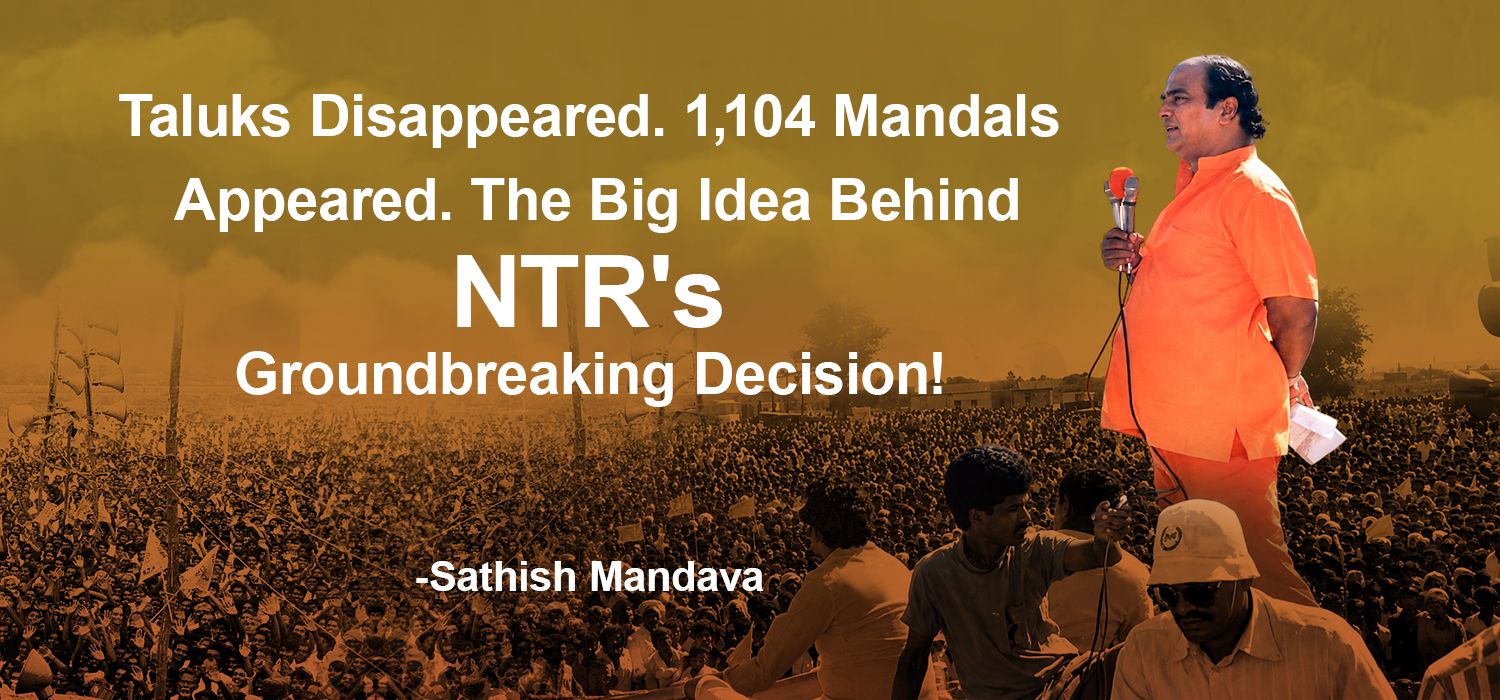
Governments often declare "landmark reforms," although many retain their importance only until the next policy declaration. At times, an administrative reform truly merits consideration as it seeks to tackle a fundamental issue rather than implement another policy alteration.
The establishment of 1,104 Mandals was a significant endeavour in administrative restructuring. To comprehend the importance of this decision, one must first grasp the shortcomings of the previous Taluka system that it aimed to rectify.
The previous system was structured around rather big administrative divisions. Although this framework might have seemed effective in theory, it frequently resulted in government services being physically inaccessible to average individuals, especially those residing in rural and isolated regions.
And thus, 1,104 micro-mandals have been established.
For a citizen, accessing a government office may necessitate significant travel, transportation costs, time away from work, and multiple trips in order to complete even standard administrative tasks. In reality, the government was involved—but frequently not adequately reachable.
For agriculturalists and rural inhabitants, tasks like acquiring documentation, transferring land titles, or securing governmental aid may consequently evolve into lengthy and burdensome endeavours. The gap between the populace and the administrative hub was increasingly hindering efficient governance.
This was the primary issue that the Mandal reform sought to tackle.
Rather than persisting with extensive administrative regions, the strategy was to establish smaller, more controllable entities and to position government administration in closer proximity to the populace. The primary aim was to render the state apparatus reachable at a significantly reduced distance from settlements, frequently articulated as a 10–15-kilometre radius.
In theory, the idea seemed uncomplicated: Smaller administrative units. Shorter distances. Closer government.
However, executing such a change proved to be somewhat complex. The establishment of over a thousand new administrative jurisdictions necessitated that the government promptly set up offices, infrastructure, people, and administrative systems throughout a significantly expanded network of sites.
The reform consequently generated a dilemma. It geographically connected the government to the populace; yet, it also necessitated the establishment of a substantial new administrative framework that required personnel, resources, and operational readiness. The outdated Taluka system possessed clear constraints. However, substituting a limited quantity of major administrative hubs with 1,104 Mandals resulted in overseeing a significantly more decentralized administrative framework. The task has evolved beyond merely creating an improved administrative map.
Do not compel the person to journey further to access government services. Enhance the proximity of government to the populace. The establishment of 1,104 Mandals signified far more than only a modification of administrative borders. It was an endeavour to radically reconfigure the association between the government and the common public.
However—and this is a crucial aspect of the narrative—the reform's aspirations also engendered a novel dilemma: how can one provide sufficient infrastructure, skilled personnel, and administrative capabilities across over a thousand new facilities? The conflict between enhanced accessibility and increased administrative intricacy is crucial for comprehending both the potential and the limitations of the Mandal system.
Presenting NTR and the Mandals: An Expert Course in Disruption!
NTR didn’t just move a few boxes around on an organizational chart; he replaced the old-school talukas with a hyper-localized mandala system. He was doing open-heart surgery on the administrative anatomy of the state.
The mandate was simple, elegant, and almost weaponized for populist appeal: bring the state within a tight 10-to-15-kilometre radius of every single village.
Now think about that metric for a second. Ten to fifteen kilometres. In theory, no citizen should have to travel more than a short cycle or bike ride or an autorickshaw hop to reach government headquarters. It was a kind of grassroots democracy in a catchy, highly marketable phrase.
- Politically? Absolute genius.
- In terms of operations? A ticking time bomb.
Because the administration instantly can’t create the infrastructure needed to support current districts when it decides to divide them into 1,104 micro-mandals overnight. The regime’s headaches were simply multiplied by a thousand. On the other hand, the political opponents and wings of media and bureaucracy described the decision as haphazard, hasty, political and a logistical nightmare for anyone who had to implement it on the ground.
Although this profoundly progressive decision brought other obstacles along with it, such as inadequate infrastructure reliant on transient and fragile facilities, a scarcity of qualified personnel leading to a disproportionate number of current staff, and an understaffed administration, NTR tapped into a very real, very deep resentment of a distant, aloof bureaucracy. He reduced the distance between the citizen and the state, forging an emotional connection that could overcome administrative hiccups. For the average villager, the mandal office, no matter how dilapidated its physical structure, was about proximity. It meant getting in. Even if the clerk was not present or there was no stamp, the belief that the government was nearby altered the psychological contract between the ruler and the ruled.
The Long-Term Footprint! The system had lived. It shifted.
Governments change, chief ministers come and go, political slogans change, and administrative priorities change. But a reform that truly solves an operating problem outlives the politics that created it. A positive example is the Mandal system. The formation of 1,104 mandals was institutionalized in the administrative framework of Andhra Pradesh and was also acknowledged in the ensuing official and parliamentary records. That matters, because if the reform were just political drama, it would have been easy for a subsequent government to tear it down. Instead, the system remained, perhaps the best evidence that, however controversial its dimensions, the reform met a real administrative need and created a structure useful enough to survive changes of government.
And today, decades later, we comfortably live with the architecture of that massive gamble. Those 1,104 micro-mandals evolved, stabilized and eventually matured. Concrete buildings replaced tin sheds, digital records replaced moth-eaten ledgers, and subsequent generations of bureaucrats figured out how to grease the wheels of this hyper-fragmented machine over time. The young officers today enter mandal offices with fast internet and automated workflows, not knowing the absolute chaos the predecessors had to wade through to keep the lights on in the transitional years.
And sometimes when the structure becomes the bottleneck, changing the structure becomes unavoidable. ‘CLASSIC’.
